mg vs mcg: The Critical Difference
Understanding milligrams and micrograms could prevent a 1,000x dosing error. This is the most important safety concept to master.
The Core Difference: A Matter of 1,000
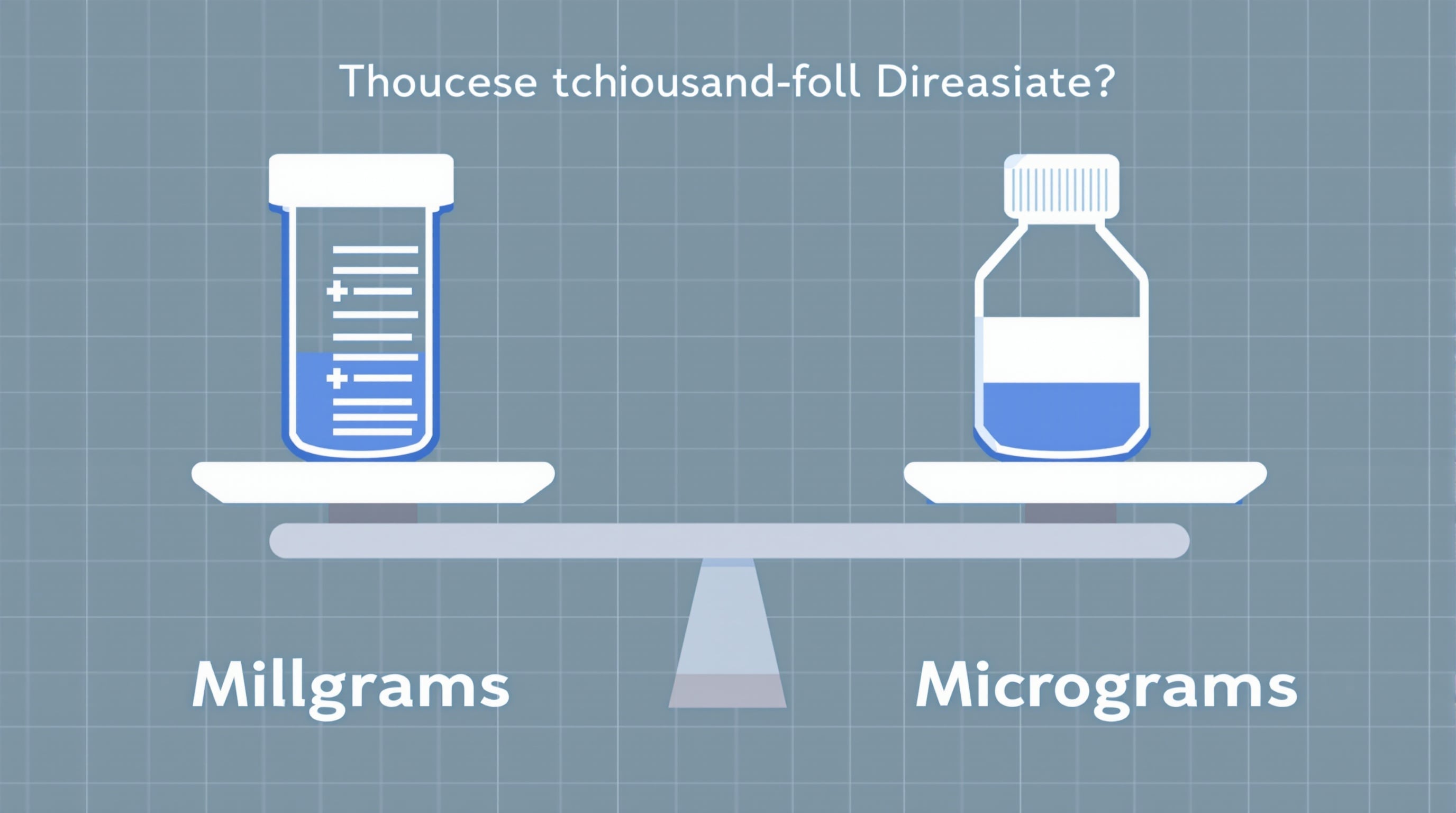
It's simple: a milligram is 1,000 times larger than a microgram.
1 mg = 1,000 mcg
1 mcg = 0.001 mg
Think of it like this: a milligram is a small crumb, while a microgram is a tiny speck of dust from that crumb.
This difference might seem academic until you realize that confusing the two units can lead to a dosing error of 1,000 times the intended amount.
Why This Matters for Peptides
Peptides are potent substances that are active in the body at very small quantities. Dosing is often measured in micrograms (mcg) to ensure precision. This is where confusion becomes dangerous.
⚠️ Common Deadly Mistake:
A beginner might see a dose listed as "500 mcg" and mistakenly measure out 500 mg.
This would be a 1,000 times overdose, which could have serious and dangerous consequences.
This is not a theoretical concern—unit confusion is one of the most common and potentially dangerous mistakes in peptide research. Always double-check your units before measuring any dose.
Conversion Examples
The math is straightforward. To convert from mg to mcg, you multiply by 1,000. To convert from mcg to mg, you divide by 1,000.
mg to mcg (multiply by 1,000)
0.5 mg = 500 mcg
1 mg = 1,000 mcg
2.5 mg = 2,500 mcg
5 mg = 5,000 mcg
10 mg = 10,000 mcg
mcg to mg (divide by 1,000)
250 mcg = 0.25 mg
500 mcg = 0.5 mg
1,000 mcg = 1 mg
5,000 mcg = 5 mg
10,000 mcg = 10 mg
Practical Example: Real-World Scenario
Imagine a research protocol calls for a dose of 250 mcg of a peptide. The peptide comes in a vial containing 5 mg of powder.
Step-by-step breakdown:
- 1
Convert vial amount to same unit:
5 mg = 5,000 mcg
- 2
Calculate how many doses in the vial:
5,000 mcg ÷ 250 mcg = 20 doses
- !
If you accidentally used the entire 5 mg vial:
You would be administering 5,000 mcg—a dose that is 20 times higher than required!
This illustrates why you must always double-check your units and calculations before measuring any dose.
Safety Checklist: Avoiding Unit Confusion
✅ Always Do This:
- • Convert all amounts to the same unit before calculating
- • Write down your calculations and double-check them
- • Use a calculator—don't do mental math with dosages
- • Label your vials with concentration after reconstitution
- • Use our reconstitution calculator
❌ Never Do This:
- • Assume mg and mcg are the same
- • Rush through dosage calculations
- • Mix units (e.g., peptide in mg, dose in mcg without converting)
- • Rely on memory for conversion factors
- • Skip verification of your calculations
Use Our Reconstitution Calculator
Our calculator automatically handles all unit conversions and shows you exactly how many units to draw up. Take the guesswork out of dosing.
Try Calculator